· Education · Sayasone Phongvichith
How to build a rehab budget that holds up
The renovation budget feeds two of the numbers on every tear sheet: cost and after-repair value. Here is how to build one the desk can read in a single pass.
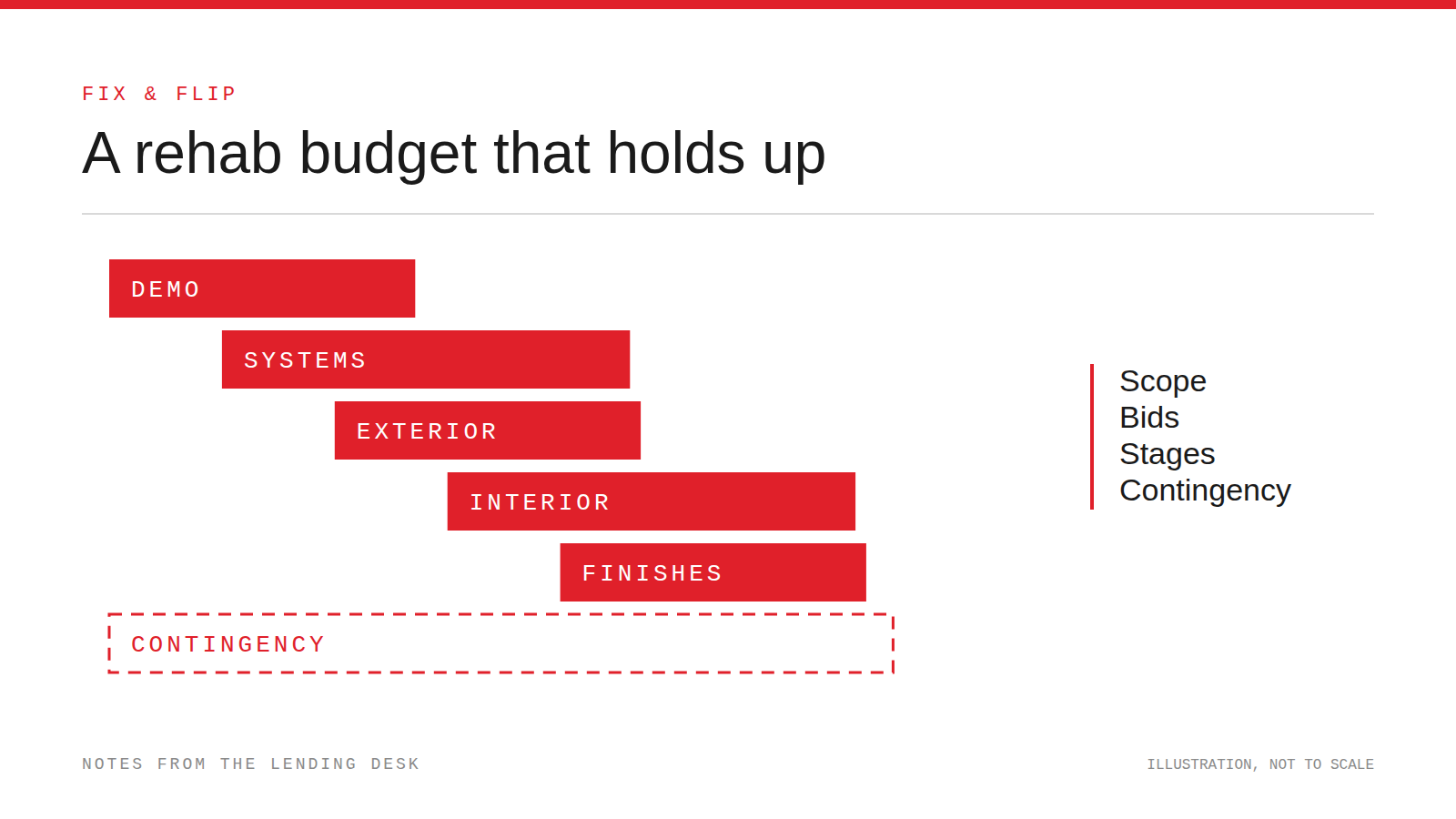
In our last post we covered LTC, LTV and ARV-LTV. Two of those three numbers depend on your renovation budget. It is part of your total cost, and it drives the finished value you are projecting. A budget that is too low makes a deal look better than it is. A budget that is too vague makes it hard to evaluate at all.
Start from a scope of work
A budget is a price list for a plan, so write the plan first. Walk the property room by room and note what will be removed, repaired or replaced. Then group the work into stages, such as demolition, structure and systems, exterior, interior and finishes.
Get real numbers
For each line, use a contractor bid where you can. For items you cannot bid yet, use your own recent invoices from similar work, not a number from memory. Write down where each figure came from. When the desk sees a budget with sources, it is easier to trust.
Match the budget to the comps
Your budget should buy the finish level of the comparable sales behind your ARV. If the comps have new kitchens and baths, those belong in the budget. If your budget is lighter than the comps, your ARV may be too high. If it is heavier, you may be spending more than the property needs.
Leave room for what you cannot see
Older properties hide problems behind walls and under floors. Include a contingency line, and keep it separate from the line items so it is clear what it is for.
Think about timing
Show roughly when each stage happens. Work is paid for in stages, and renovation draws are released against completed work, so a staged budget also helps you plan your cash.
Send the budget with the scenario
A clear, staged budget with sources answers most of what the desk would otherwise ask. Include it with your scenario along with the purchase price and your expected value.
Program figures are indicative only and subject to complete documentation, underwriting, appraisal and final credit approval. This post is general information, not financial or legal advice.