· Education · RED Lending
Choosing a Neighborhood for Your Next Flip: What to Look At Before You Buy
A good house in the wrong neighborhood is a hard sale. Here is how to read a neighborhood before you buy a flip, from how fast homes sell to what buyers will pay.
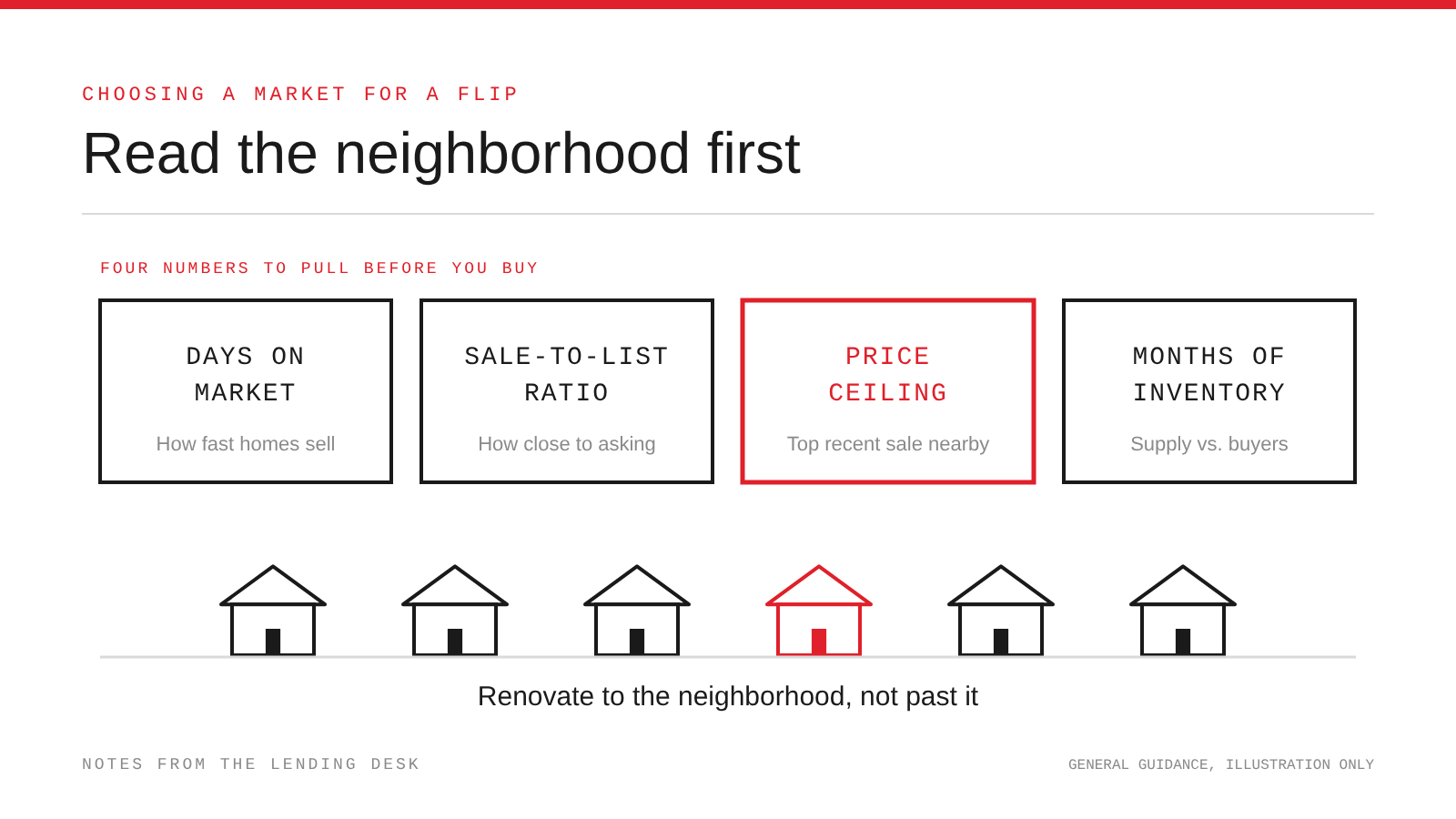
A flip is sold to a buyer who is choosing the neighborhood as much as the house. You can fix almost anything inside the walls. You cannot fix the block. Reading the neighborhood before you buy tells you who your buyer is, what they will pay and how long the house is likely to sit.
Start with who will buy it
Picture the buyer before you picture the finishes. A first-time buyer with a low down payment, a move-up family and a downsizing couple want different houses and shop at different prices. Look at who has bought nearby in the last year. The renovation should fit that buyer, not your own taste.
Pull four numbers
- Days on market: how long renovated homes nearby took to go under contract. Every extra month is another month of holding costs.
- Sale-to-list ratio: how close homes sold to their asking price. Steady sales below asking can mean buyers have the upper hand.
- Price ceiling: the highest recent sale for a similar house in the immediate area. Few buyers will pay much above it, however nice the kitchen is.
- Months of inventory: how many months it would take to sell every home now listed at the current pace. A rising number means more competition when you list.
Your agent can pull these from the local listing service. Use sales from the last 6 to 12 months and stay as close to the house as you can.
Renovate to the neighborhood, not past it
The most common way to lose money on a good house is to finish it above the street. If the best sale nearby is $350,000, a renovation that needs $425,000 to break even is a bet against the market. Match the finish level, the bedroom count and the features to what the top recent sales had.
Walk the block
Data will not tell you everything. Visit at different times of day and on a weekend. Notice the condition of the houses around yours, traffic, noise, nearby businesses, rail lines and how the street drains in heavy rain. If you would hesitate to buy there yourself, a retail buyer may too.
Check what is coming
Look up planned roads, new construction and zoning changes nearby. Ask the city how long permits are taking. A permit office that takes two months adds two months of holding costs before the work starts. Check the flood map too, since flood insurance can change what a buyer can afford.
Watch for warning signs
- Many listings with price cuts
- Inventory climbing month over month
- Several renovated flips listed at the same time near yours
- Long gaps between sales, which makes the value harder to support
How the neighborhood shows up in the loan
The appraiser values the finished house against nearby sales. A plan that fits the neighborhood is easier to support at appraisal, and an after-repair value that runs well past the area's sales is harder. Include your comps and a short note on the area with your scenario.
Program figures are indicative only and subject to complete documentation, underwriting, appraisal and final credit approval. This post is general information, not financial or legal advice.