· Education · RED Lending
Estimating Rental Cash Flow: What the Rent Has to Cover Besides the Loan
The rent has to pay for more than the mortgage. Here is how to estimate vacancy, repairs, big-ticket replacements and the other costs before you buy a rental.
A rental can pass a lender's numbers and still lose money month to month. The loan payment is only one of the bills the rent has to cover. An honest estimate of everything else is what tells you whether the property will put money in your pocket.
Start with a rent you can support
Use the current lease if there is one, and check it against similar rentals nearby. Look at what units actually rented for, not just what landlords are asking. If the property is vacant, a conservative market rent is safer than the top of the range.
Plan for vacancy
Units sit empty between tenants. Even one month empty in a year is about 8% of the year's rent, before cleaning, paint and listing costs. Many investors set aside 5% to 10% of rent for vacancy, depending on the area and the type of tenant.
Budget for repairs
Toilets run, locks break and appliances fail. Set aside a share of the rent every month for ordinary repairs. Older homes and homes with original systems need more.
Set aside for big-ticket replacements
Roofs, furnaces, water heaters and appliances wear out on a schedule. A simple way to budget: take the replacement cost, divide it by the years of life left, and save that amount each year. A $12,000 roof with 10 years left is $100 a month. A recent inspection gives you the ages to work from.
Count the fixed costs
- Property taxes, which can go up after a sale or a reassessment
- Insurance, including flood coverage if the property needs it
- HOA dues, if any
- Utilities the owner pays, such as water, sewer or trash
- Property management, if you hire it out, often a percentage of the rent collected
- Lawn care, snow removal and pest control
Put it together
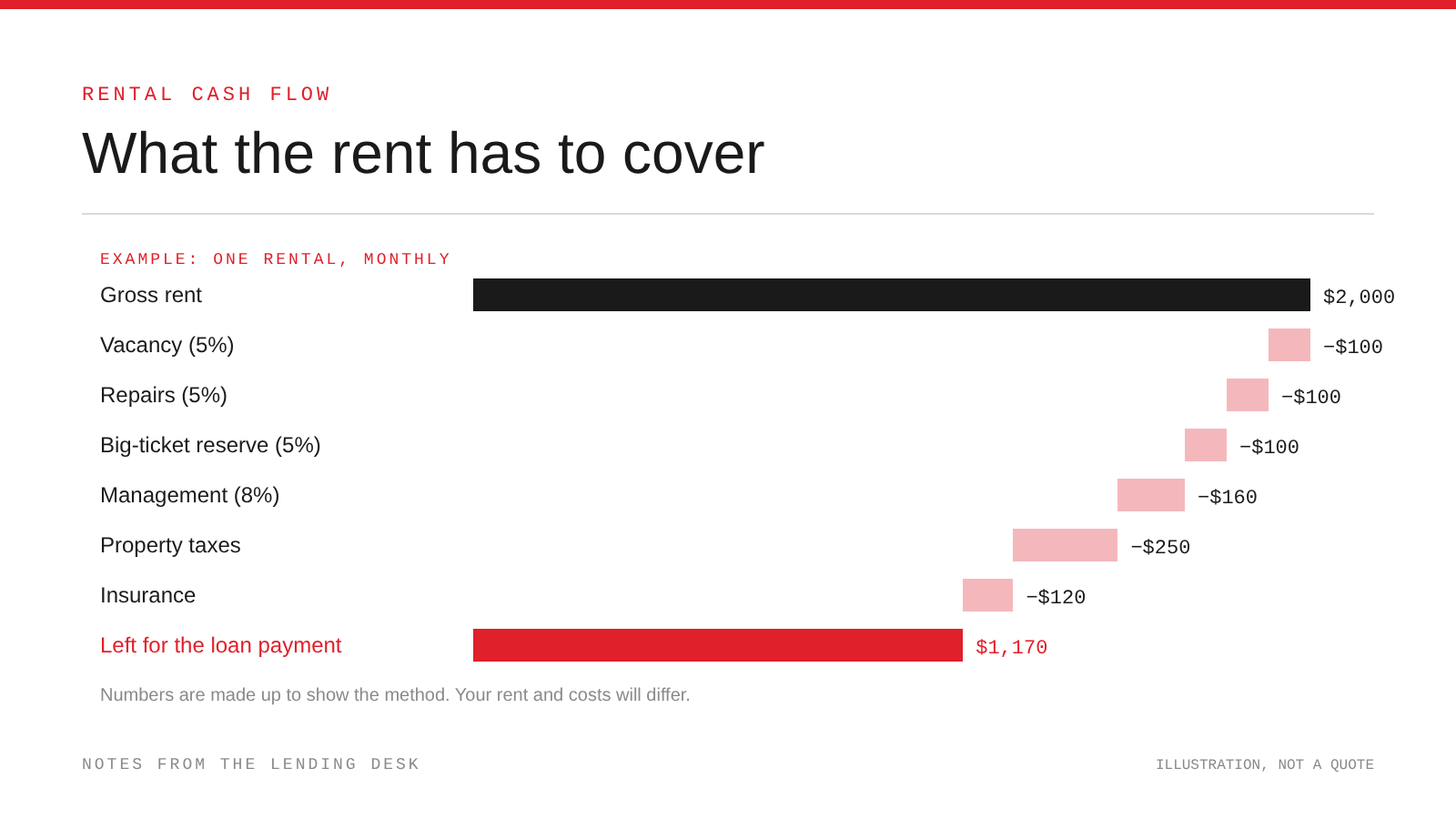
Here is a made-up example to show the method. Rent is $2,000 a month. Set aside $100 for vacancy, $100 for repairs and $100 for big-ticket replacements. Management at 8% is $160. Taxes are $250 and insurance is $120. That leaves $1,170 a month for the loan payment and your return. If the payment is $1,050, the true cash flow is about $120 a month, not the $950 the rent alone suggests.
How this differs from DSCR
On a DSCR rental loan, the lender compares the rent to the full monthly payment: principal, interest, taxes, insurance and association dues. It does not subtract vacancy, repairs or management. That makes it a test of whether the rent carries the loan, not a full measure of your profit. Run both.
Keep a cash cushion
Even a careful estimate will be off in some months. Keep cash on hand for the month the furnace fails and the unit sits empty at the same time.
Program figures are indicative only and subject to complete documentation, underwriting, appraisal and final credit approval. This post is general information, not financial or legal advice.