· Education · Sayasone Phongvichith
How renovation draws work, and how to set up your budget for them
Renovation money on a Fix & Flip is released against completed work. Here is what that means for your budget and your schedule.
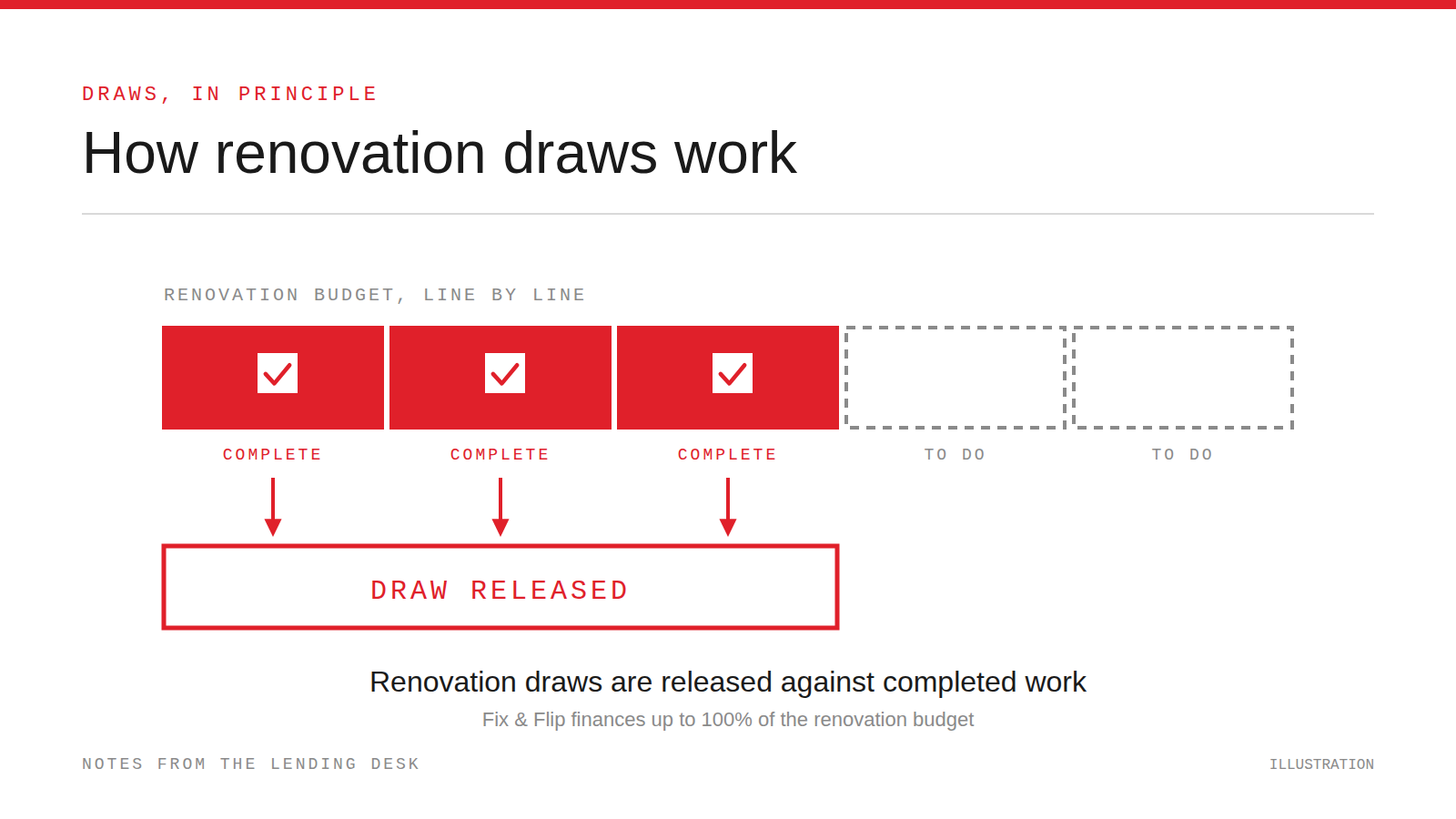
On a Fix & Flip, the renovation money does not arrive in one lump at closing. It is released in draws, and the published rule is simple: renovation draws are released against completed work.
What is financed
Fix & Flip finances up to 100% of the renovation budget. The renovation budget is capped at 2x your highest verified past project, up to $500,000. First-time investors are capped at a $100,000 renovation budget.
How interest works on the holdback
On loans of $100,000 or more, interest accrues as funds are disbursed. On loans below $100,000, interest is charged on the total loan amount.
Why the budget matters
The desk asks for a scope of work with a line-item renovation budget. That document sets what the work is and what it costs, and it is what a draw is measured against. A vague budget makes every draw a conversation. A clear one makes it a checklist.
Practical habits (general advice)
- Break the budget into line items you can point to: a finished item is easy to verify, a half-finished one is not.
- Keep your contractor's invoices and your own photos organized by line item.
- Pace the work so you can carry costs between completion and reimbursement.
- Do not let the scope change on the job without telling the desk.
What is not published
The draw schedule and procedures are not on our site, so ask the desk how draws work on your file before you close. Each loan is different.
What to send the desk
The contract, a line-item scope of work and budget, your track record, and the guarantor and entity documents. Pricing is quoted per deal.
Program figures are indicative only and subject to complete documentation, underwriting, appraisal and final credit approval. This post is general information, not financial or legal advice.