· Education · Sayasone Phongvichith
The 70% rule: a useful shortcut, and where it breaks down
Many flippers screen deals with the 70% rule. Here is how it works, why it is only a first pass, and how it relates to the leverage numbers on a tear sheet.
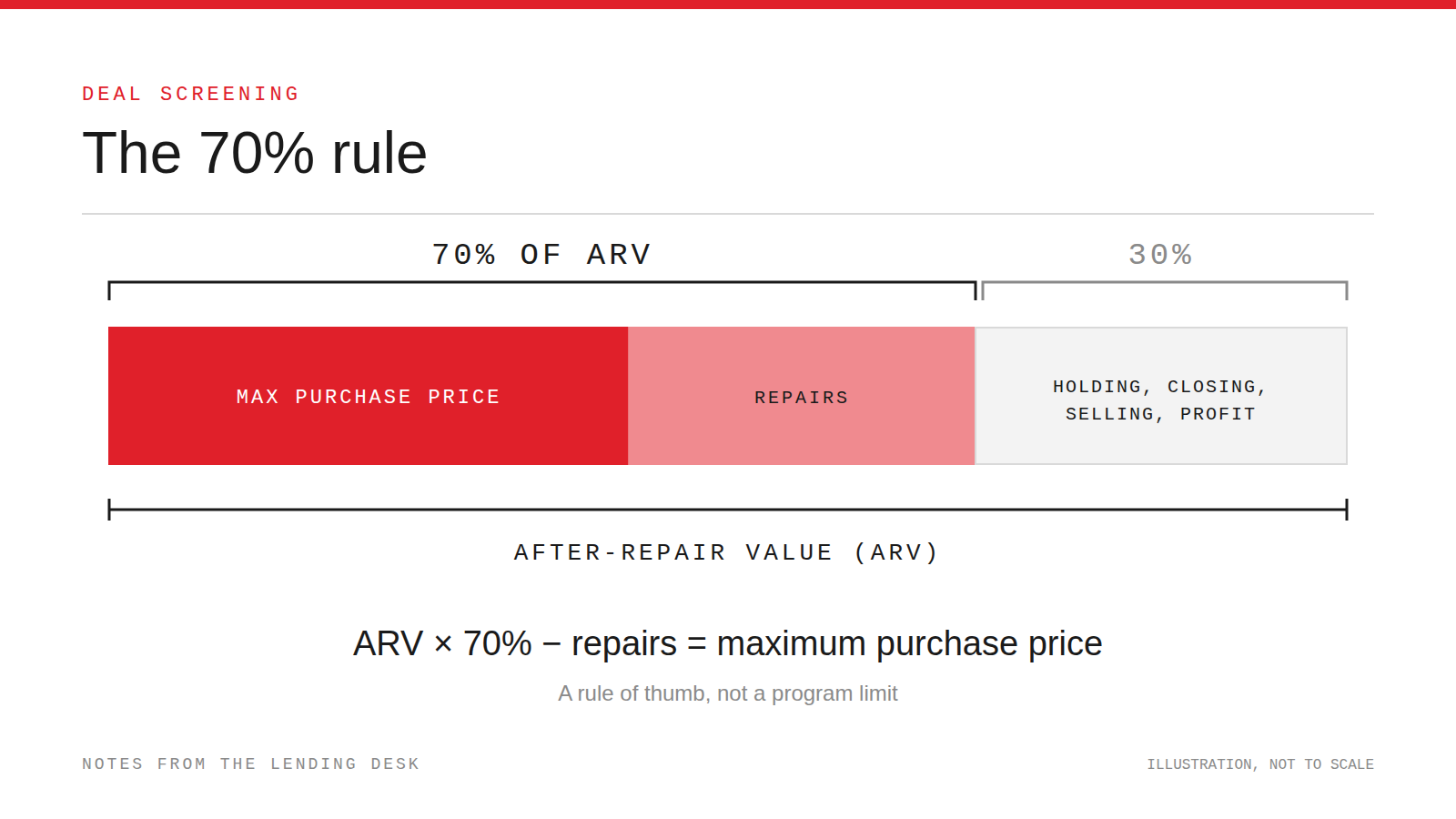
The 70% rule is one of the most common ways investors screen a flip. It is a rule of thumb from the investing community. It is not a RED underwriting guideline, and it is not a limit on any of our programs.
How it works
The rule says a flipper should pay no more than 70% of the after-repair value (ARV), minus the cost of repairs.
For example, if a house will be worth $300,000 after renovation and needs $50,000 of work, the rule gives a maximum purchase price of $160,000: 70% of $300,000 is $210,000, less $50,000 for repairs. This example uses made-up numbers for illustration only.
The 30% that the rule leaves out is meant to cover everything else: holding costs, closing costs, selling costs and profit.
Why investors like it
It is fast. You can run it in your head on a property you are walking through, and it forces you to start from the finished value and work backward, which is a healthy habit.
Where it breaks down
- It ignores your timeline. A six-month project and a twelve-month project cost very different amounts to carry.
- Markets differ. In a hot market, the rule may never find a deal. In a slow one, 70% may be too generous.
- Small projects and big projects are not the same. Fixed costs weigh more heavily on a smaller deal.
- It depends entirely on your ARV and your repair estimate. If either is off, the answer is off.
How it relates to the tear sheet
The 70% rule is a purchase-price screen. A loan is sized separately, against cost and against value. On Fix & Flip, the published limits are 90% LTC and 75% ARV-LTV. A deal can pass the 70% rule and still be limited by one of those figures, and the reverse is also true. Use the rule to decide whether to chase a deal, and the program limits to see how it could be financed.
Run it both ways
Run your numbers through the 70% rule and through the program limits, then send both to the desk with your scenario.
Program figures are indicative only and subject to complete documentation, underwriting, appraisal and final credit approval. This post is general information, not financial or legal advice.